 Changelly
 swap cancellation options depend on whether funds have reached the payout stage
Changelly lets an unfunded swap order expire automatically when you do not send the deposit. After funding, contact support immediately to request intervention before the payout. Support may have a limited opportunity to stop processing or correct a recipient address, but stopping an exchange does not necessarily make it refundable. Once the exchange has a payout transaction hash, cancellation is no longer available. A refund requires a separate eligibility decision and, if approved, a return transfer.
In short: Stopping a funded swap requires support review, and a possible address correction does not establish eligibility for a refund.
Leaving an unfunded order versus stopping a funded swap
Leaving an unwanted order unfunded allows it to expire; a deposit you have already sent requires support to examine the exchange. Check your sending wallet before treating an order as unpaid. An order screen alone does not establish whether you submitted a transfer.
If no transfer exists, there are no deposited funds to reclaim. If your wallet shows a submitted payment, preserve its transaction hash and contact support about the existing order. Closing the browser does not recall that payment. Explain whether you want to stop the exchange or correct an error, since those requests can lead to different outcomes.
Can support change the recipient address before payout?
Support may be able to correct a recipient address if it can stop an unfinished exchange before sending the payout. This opportunity is limited. A request does not reserve time for an amendment, and an absent payout hash on your screen does not prove support can still intervene.
Identify the incorrect destination. Before providing a replacement through the support conversation, check that it supports the payout asset and network, including any required memo or destination tag. Address correction preserves the intended exchange while changing its destination; a refund asks for the deposited asset back. Support may be able to help with the former even when the latter is unavailable.
Records support needs to identify the payment
The exchange order ID identifies your case, while the deposit transaction hash identifies the payment your wallet submitted to the network. Include both when requesting help with a funded order.
Keep the original order details, the destination you entered, the displayed status, and any relevant screenshot. Describe the error and requested change directly. These records let support connect your request with the correct exchange without relying on an approximate amount or time. Preserve subsequent replies alongside the original details so an approved correction or refund remains traceable.
A deposit hash proves a payment record exists. It does not prove the exchange has stopped or a refund has begun.
Late deposits and failed exchanges need different decisions
A late deposit needs review against the expired order, while a failed exchange needs a decision about resuming processing or returning recoverable funds.
Funds arriving after the funding window
Expiry does not itself send deposited crypto back. A late payment may require manual processing or a refund, subject to the order conditions and technical feasibility. Keep the expired order ID associated with that payment when contacting support. Creating another order does not explain what happened to the earlier deposit.
An exchange stopping during processing
A failed status also does not establish a completed refund. Available choices can include continuing the exchange or returning funds. If the deposited amount cannot cover the network fee for the return, it is non-refundable. Before accepting continued processing, establish the applicable rate and expected output; before accepting a refund, establish its deductions and destination.
Verification holds require a response to the hold
A verification hold means the service requires additional checks before it can resolve the transaction, rather than offering an ordinary cancellation window. Its risk assessment can trigger identity checks and requests for information about the funds.
Ask which requirement remains outstanding and whether it affects the requested return. A cancellation request does not establish that the compliance team has cleared the transaction. Keep sensitive documents within the designated verification process; publicly posting identity records does not resolve the hold.
The refund amount and arrival estimate are separate questions
Refund eligibility, the amount available for return, and an arrival estimate each answer a different part of the recovery request. An approval alone does not settle all three.
Deductions from the return
Applicable network fees and recovery costs can reduce the amount you receive. Ask support to identify the deductions before agreeing to the return. Where recovery requires operating costs and network fees, the terms provide for prior user consent to those deductions. Compare the approved refund with the deposited asset amount, rather than its changing market value.
An estimate tied to the case
Cases can be refundable with an estimated arrival time, refundable without one, or non-refundable. Technical recovery and partner involvement can affect whether support can give a usable estimate. A first response is not a refund dispatch notice. Confirm whether support is awaiting your address, completing recovery, or preparing the return transfer.
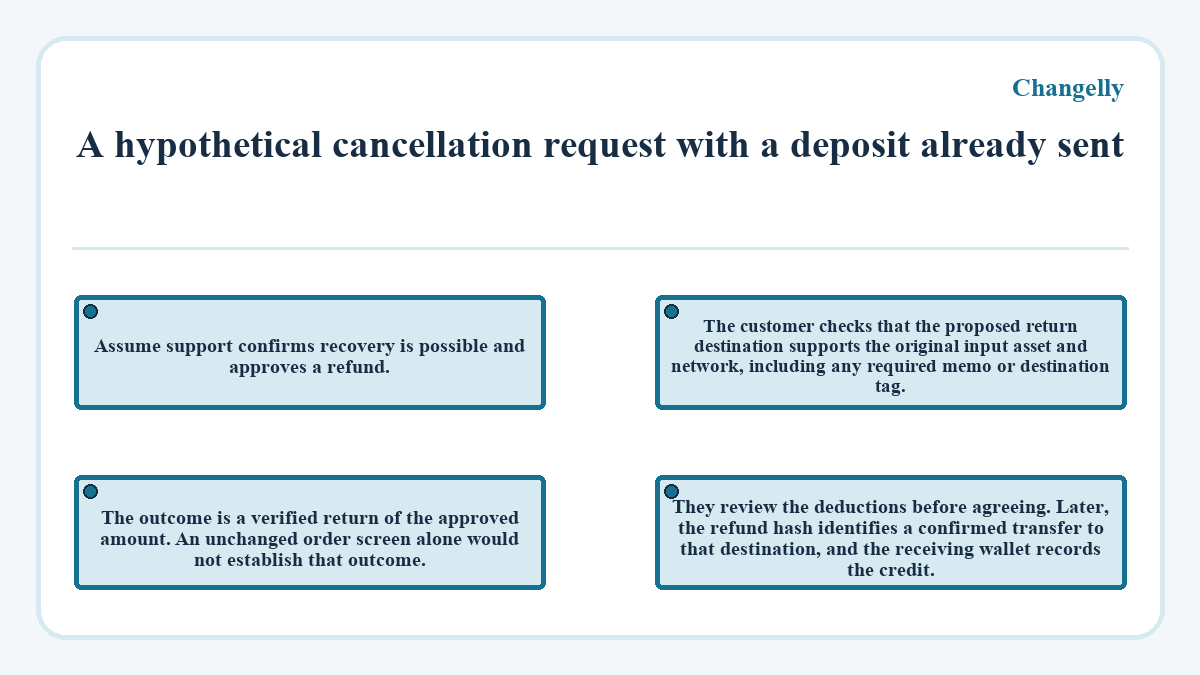
A hypothetical cancellation request with a deposit already sent
In this hypothetical example, a customer no longer wants an exchange and believes they have not funded it. They check the sending wallet before leaving the order to expire. The order status, wallet record, support decision, and receiving balance are all hypothetical.
If the wallet confirms that the customer submitted no deposit, they leave the order to expire. No return transfer is necessary because they kept the funds.
If the wallet instead shows a submitted deposit, while the exchange screen shows no payout hash, the customer makes no further payments. They send the existing order ID and deposit hash to support so the team can investigate that payment without another deposit to reconcile.
Assume support confirms recovery is possible and approves a refund. The customer checks that the proposed return destination supports the original input asset and network, including any required memo or destination tag. They review the deductions before agreeing. Later, the refund hash identifies a confirmed transfer to that destination, and the receiving wallet records the credit. The outcome is a verified return of the approved amount. An unchanged order screen alone would not establish that outcome.
Confirming the return through its own transaction record
A refund has its own transaction hash, separate from the deposit and any exchange payout, so trace the return using that identifier. The transaction record distinguishes the refund address and refund hash from the original payout details.
Compare the return destination with the address you approved, then check the transfer status and receiving wallet record. A support message approving the refund documents the decision; the return transaction documents its execution. If the approved refund amount differs from the received amount, retain both records and ask support to reconcile the difference.
Keep the refund hash with the original order ID, even after the receiving wallet shows the credit.
A completed payout moves recovery to the destination
Once the service has sent the payout, recovery concerns the receiving address or wallet rather than cancellation of the exchange. Changelly cannot cancel an exchange once it has a payout transaction hash.
If the destination belongs to a receiving service, its support team may need to investigate a missing credit or compatibility problem. Its ability to recover funds depends on the actual destination and transfer. If you accidentally used a Changelly address as the recipient, contact Changelly about that specific recovery case. Preserve the payout hash: it identifies the transfer now under investigation.
Frequently asked questions about Changelly
When can I replace an unfunded fixed-rate order?
Wait for the unfunded fixed-rate order to expire before creating its replacement. For an unfunded floating-rate order, the transaction guidance permits creating another order without that wait. This distinction applies to abandoning an order before payment; an existing deposit still needs separate attention.
Does finding a better exchange rate qualify me for a refund?
Disliking the exchange rate does not by itself qualify a completed exchange for a refund. A floating-rate transaction that stops because of a significant rate change is a different case: a possible refund depends on its processing state, feasibility, and applicable fees.
Which asset must my refund address support?
The refund address must support the original input asset for the return, including the applicable network and any required destination information. Do not assume the address intended for the exchanged output can receive the refund. The transaction record treats the payout address and refund address as separate fields.
Should I open another ticket while technical support reviews my refund?
Keep follow-ups in the existing case and include the original transaction ID. Repeating an inquiry after support has forwarded it to technical or financial specialists can add to the support queue. Add new evidence or request clarification of the outstanding issue without creating parallel accounts of the same payment.
Are card-purchase refunds governed by the same rules as crypto swaps?
Card purchases through a payment provider follow that provider's applicable policies and terms. Identify the provider responsible for the purchase before requesting cancellation or a refund. Crypto swap expiry and payout rules do not establish the refund conditions for a separate payment-provider order.