 Changelly
 exchanges cryptocurrency through funded orders and sends the proceeds to your receiving address
Changelly is a cryptocurrency exchange service that converts deposited crypto and sends the resulting asset to your chosen wallet address. It also provides purchase and sale options through payment providers. For a standard swap, the quote, deposit, exchange status, and payout record describe different parts of the transaction. Creating an order does not itself transfer your funds.
The important distinction is between preparing an exchange and funding it. Before sending, you can reconsider the quote. After sending, completion depends on the deposit details, network confirmations, exchange processing, and any verification requirements.
A swap remains optional before funding; afterward, its status and payout record show what happened to the transferred cryptocurrency.
Swap orders, payment providers, and receiving wallets
The standard exchange connects a crypto deposit with a payout in the selected asset. Your sending wallet funds the order; your receiving address determines where the proceeds go. The service processes the conversion between those transfers. Prepare a compatible receiving address before creating the order, including any additional destination information the receiving service requires. Changelly also has separate trading and integration products, so an exchange order should not be confused with a trading-account balance.
Buying and selling introduce a payment provider. A purchase converts a supported fiat payment into crypto delivered to an address. A sale converts crypto into a supported fiat payout. Provider availability, verification, payment methods, and processing times govern those routes. Direct Buy keeps the purchase interface within Changelly, while a provider still processes the transaction. Keep the provider's order record because it identifies the purchase or sale when payment support becomes necessary.
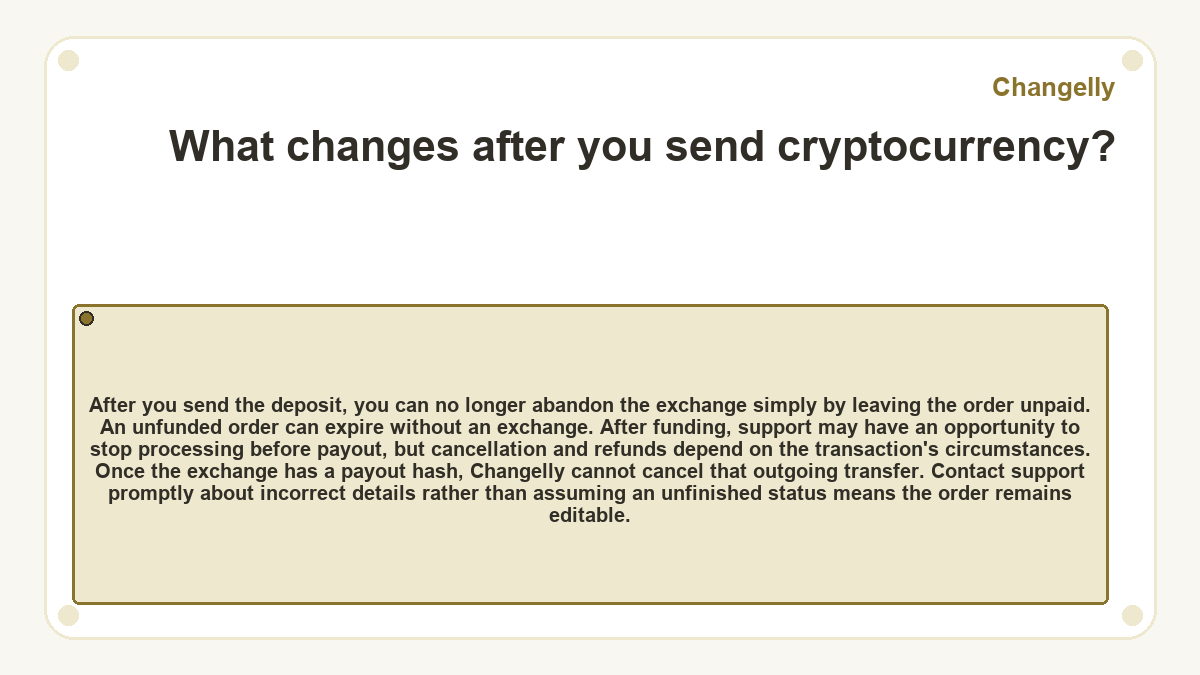
What changes after you send cryptocurrency?
After you send the deposit, you can no longer abandon the exchange simply by leaving the order unpaid. An unfunded order can expire without an exchange. After funding, support may have an opportunity to stop processing before payout, but cancellation and refunds depend on the transaction's circumstances. Once the exchange has a payout hash, Changelly cannot cancel that outgoing transfer. Contact support promptly about incorrect details rather than assuming an unfinished status means the order remains editable.
Should you choose a fixed or floating rate?
A fixed rate suits an exchange requiring a predictable quoted output, provided you meet its funding conditions; a floating rate allows the output to change with market conditions. Review the amount you will receive alongside the displayed charges. Fixed pricing does not remove network delays or verification requirements.
The funding conditions behind the quote
Fixed rate
The fixed quote requires the correct incoming amount and timely funding. Account for any deduction your sending service makes before funds reach the deposit address. Read the order's payment deadline before committing; an expired quote does not retain its original terms merely because you saved it.
Floating rate
The displayed output is an estimate. Market movements during processing can increase or decrease the final amount. Both rate choices have costs, so compare the quoted receiving amount for the same input instead of treating either rate label as a fee statement.
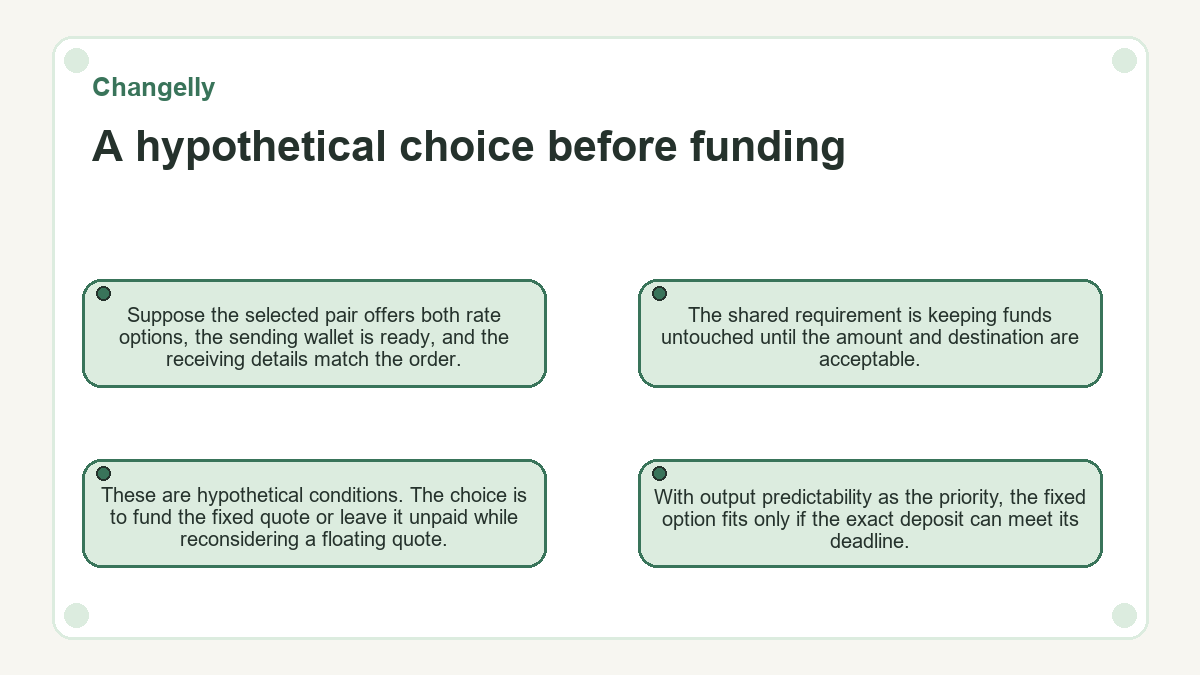
A hypothetical choice before funding
Suppose the selected pair offers both rate options, the sending wallet is ready, and the receiving details match the order. These are hypothetical conditions. The choice is to fund the fixed quote or leave it unpaid while reconsidering a floating quote. The shared requirement is keeping funds untouched until the amount and destination are acceptable. With output predictability as the priority, the fixed option fits only if the exact deposit can meet its deadline.
Under those assumptions, funding the fixed order commits the deposit. A change to Confirming shows the service has moved to waiting for sufficient blockchain confirmations; it does not prove payout. If you discover before sending that the service cannot deliver the specified amount on time, leave the order unfunded. Let it expire before creating a replacement fixed order. If you have already sent the deposit, contact support about the original order.
Payment details that determine whether processing can proceed
The selected asset, network, deposit address, and required memo or destination tag must match the order. The receiving address must also support the payout asset on its selected network. An address passing a format check does not establish network compatibility. Review both ends before sending, and provide a compatible refund address when the order requests one. A refund address gives the service a destination for an applicable return; it does not make every deposit recoverable.
What does the transaction status tell you?
The status identifies the service's processing stage, which helps distinguish a missing payment from confirmation delays, exchange processing, or a verification hold. Waiting for payment means the service awaits funding. Confirming means it awaits enough blockchain confirmations. Exchanging indicates conversion processing; Sending identifies the payout stage, and Finished reports successful completion.
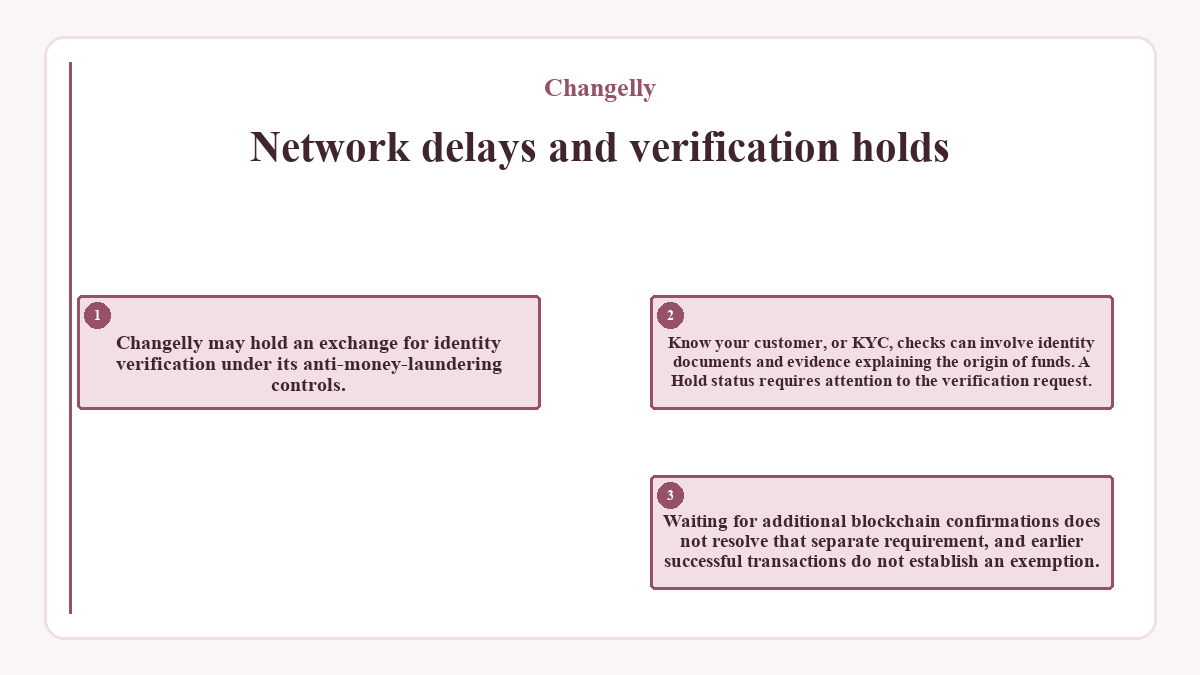
Network delays and verification holds
A deposit hash alone does not establish sufficient confirmations. Confirmation requirements vary with the input currency, and network congestion can delay progress. Exchange partners can also experience processing problems. These dependencies make the order's actual state more useful than a general speed estimate when diagnosing a delay.
Changelly may hold an exchange for identity verification under its anti-money-laundering controls. Know your customer, or KYC, checks can involve identity documents and evidence explaining the origin of funds. A Hold status requires attention to the verification request. Waiting for additional blockchain confirmations does not resolve that separate requirement, and earlier successful transactions do not establish an exemption.
Matching the completed exchange to the receiving wallet
The exchange ID identifies the order inside Changelly. A blockchain transaction hash identifies a transfer on its network. Preserve the order ID together with the incoming and outgoing hashes when available. They connect the original exchange request to the deposit and payout without confusing those separate records.
At completion, compare the payout record with the intended receiving address, network, asset, and amount. Confirm the corresponding credit in the receiving wallet or account. Use the final order amount when reconciling a floating exchange, since its preliminary estimate could change. For a sale, confirm the fiat credit at the selected payment destination as well as the provider's order result. Keep unresolved differences attached to the original order when contacting support; a new exchange creates another transaction rather than repairing the first.
A separate option, Changelly DeFi Swap, uses decentralized exchanges and smart contracts to execute swaps. That workflow introduces wallet authorization and blockchain execution rather than the standard service's deposit-and-payout process. Compare the supported pair, network, execution method, and receiving outcome when choosing between them. The standard exchange can support conversions across different blockchains, and Changelly's DeFi API also supports cross-chain swaps. Check the selected interface's supported networks; same-chain versus cross-chain availability is not a universal distinction between these workflows.
Changelly FAQs
Can a previous Changelly deposit address receive another exchange payment?
Create a new order to obtain a new deposit address. Changelly treats its generated pay-in addresses as non-reusable. Sending another payment to an earlier address can require manual handling rather than automatic exchange processing. If you already reused one, retain the payment hash and contact support about that deposit.
What happens if I omit the required memo or destination tag?
A missing or incorrect required memo can prevent automatic processing of the deposit. Contact support with the exchange ID and the payment's blockchain details. Manual handling may involve a refund or conversion at the rate applicable during that processing. Do not assume the original quoted rate remains available while support identifies the payment. If the missing memo concerns a payout already sent to your receiving account, contact the receiving service's support team about the unassigned transfer.
Does completing verification in advance prevent another verification request?
Completing verification in advance does not prevent Changelly from requesting additional verification later. Advance verification can establish a verified account record, while a later transaction may still require further checks. Follow the request attached to the affected exchange rather than treating previous approval as proof the new order cannot enter a hold.
Where can I find the record of a purchase through a payment provider?
The chosen purchase provider holds the transaction details for its fiat-to-crypto purchase. Its confirmation email can include the order information and transaction hash. Keep that record alongside the receiving address and payment receipt. When a purchase remains unresolved, the provider's order identifier helps distinguish a payment-processing issue from a crypto exchange order.
Why can a deposit below the minimum fail instead of completing a smaller swap?
The minimum must accommodate the network fee and the minimum exchangeable amount available through the market. A smaller deposit may therefore fail automatic processing. Support may assess manual exchange or refund options, but funds too small to cover the network fee may be non-refundable. Contact support before sending an additional payment.
Which mobile systems support the Changelly app?
Changelly provides apps for iOS and Android. The app supports cryptocurrency purchases, sales, and exchanges, with access to transaction history and support. Availability of a particular transaction still depends on the selected service and its requirements; installing the app does not establish eligibility for every payment method or exchange.