 Changelly
 fees combine exchange and network charges in the cost of a crypto swap
Changelly fees include exchange charges and a payout network charge, while funding the swap can create a separate sending cost. Compare quotes using the same input asset, funding basis, receiving asset, and compatible network, then identify the output after included deductions. Floating quotes can change during processing; fixed quotes depend on meeting their funding conditions. Partner integrations and fiat purchases can also use different fee arrangements. A useful comparison therefore records both the total amount leaving your funding account and the net amount reaching the destination. The difference between their values can include exchange pricing and market movement alongside explicit fees.
The short version: Comparable quotes use the same assets, compatible networks, and funding basis, with each included charge counted only once.
The amounts that belong in a complete cost comparison
A complete comparison connects the funding debit, exchange quote, and receiving amount without treating every displayed charge as an additional deduction. Record the amount the order expects, the sending service's charge, and the quoted output. Beside that output, note whether it already includes the service and payout network fees. Preserve the asset and network labels alongside each amount.
Keep fee amounts in their original units until you need a common valuation currency. An input-side charge and an output-side deduction cannot simply be added when they use different assets. Converting them with one consistent set of reference prices makes the arithmetic meaningful. It also keeps later market movement separate from the cost estimate.
Network compatibility determines which quotes belong together
A lower network charge helps only when the quoted payout matches a network the receiving wallet or account supports. The same asset name does not establish that compatibility. Confirm the receiving network and any required destination information before comparing the amounts. An address format alone may not reveal a mismatch, because different assets can share an address format.
A quote delivering an asset on a different network represents a different outcome. If reaching the intended destination requires another transfer or conversion, its costs belong in that route's total. Do not assume an additional route exists or has a particular fee. Until its compatibility and charges are known, its displayed payout cannot establish the cheaper usable result.
Floating swaps, fixed swaps, and purchases use different pricing terms
Floating and fixed swaps handle exchange-rate uncertainty differently, while fiat purchases follow the selected payment provider's pricing.
| Transaction option | Cost treatment | Condition affecting the quote |
|---|---|---|
| Floating crypto swap | Service charge and payout network charge contribute to net output. | The output estimate can change with market rates. |
| Fixed crypto swap | A dynamic exchange charge contributes to the fixed quote. | The specified funding amount and payment window apply. |
| Fiat purchase | The selected payment provider determines purchase charges. | The provider's purchase terms and transaction limits apply. |
A fixed exchange rate does not make every surrounding expense fixed. The sending service still has its own charges. Changelly also describes its displayed network charge as an estimate whose final amount can sometimes differ. Keep those expenses distinct from the exchange-rate protection when budgeting the transaction.
Network charges affect smaller exchanges disproportionately
Changelly's payout network charge does not scale directly with the amount exchanged. Its value can vary with the receiving currency and network conditions. For a given quoted network charge, a smaller exchange bears a larger proportional cost. This explains why comparing only a service percentage can miss a substantial part of a small swap's expense.
The minimum exchange amount also matters. Changelly sets it to cover the network fee and meet the market's minimum exchangeable lot. An amount below that limit is not simply a smaller version of the quoted transaction. Separately, a sending service may deduct its withdrawal charge from the submitted amount. The deposit reaching the order must still satisfy its funding requirements.
Net output prevents duplicate fee deductions
Use an explicitly net receiving amount directly, and subtract a payout charge only when the displayed amount excludes it. A fee breakdown can explain an amount without creating another payment obligation. Subtracting every visible fee again would understate the output and distort the comparison.
Raw integration data needs particular care. In Changelly Exchange API v2, the fixed-transaction field
amountExpectedTo
describes output before withholding
networkFee. For that field, net output equals
amountExpectedTo
minus
networkFee. This field-specific calculation does not mean every consumer interface displays a gross receiving amount.
Comparable quotes need a consistent funding basis and timing
Compare offers close together in time, using the same input asset, funding basis, output asset, and receiving network.
Choose whether your comparison fixes the amount entering the exchange or the total amount leaving the funding account. Those bases differ when sending costs vary. Equal exchange deposits may require unequal account debits. With a fixed overall budget, deduct external funding charges before calculating how much each route can exchange.
Changelly API partners can configure an additional commission on top of the exchange fee. An integrated wallet quote can therefore differ from a direct quote even when Changelly processes both. Record the actual offer instead of transferring one interface's fee assumptions to another.
Keep the quote time and rate mode with the figures. A floating estimate collected earlier and a fixed quote collected later describe different market conditions and commitments. Their difference cannot establish a fee difference by itself. Where both offers remain comparable, net output and total funding debit provide the clearest arithmetic comparison.
A hypothetical total after correcting an incompatible quote
Suppose a reader requests a swap quote and discovers that its receiving network does not match the destination account. No deposit has left the sending wallet. The reader excludes that quote and requests one using a network the destination supports. Before funding, the replacement must also meet its amount limits and payment conditions. This corrects the comparison without assuming funds sent through an incompatible network would be recoverable.
For this hypothetical calculation, all values use the same accounting currency and one reference-price snapshot. The exchange input has a reference value of 846 units. Assume the disclosed exchange charge equals 2.16 units and the payout charge equals 1.34 units. With no other pricing difference or market movement, net output has a value of 842.50 units.
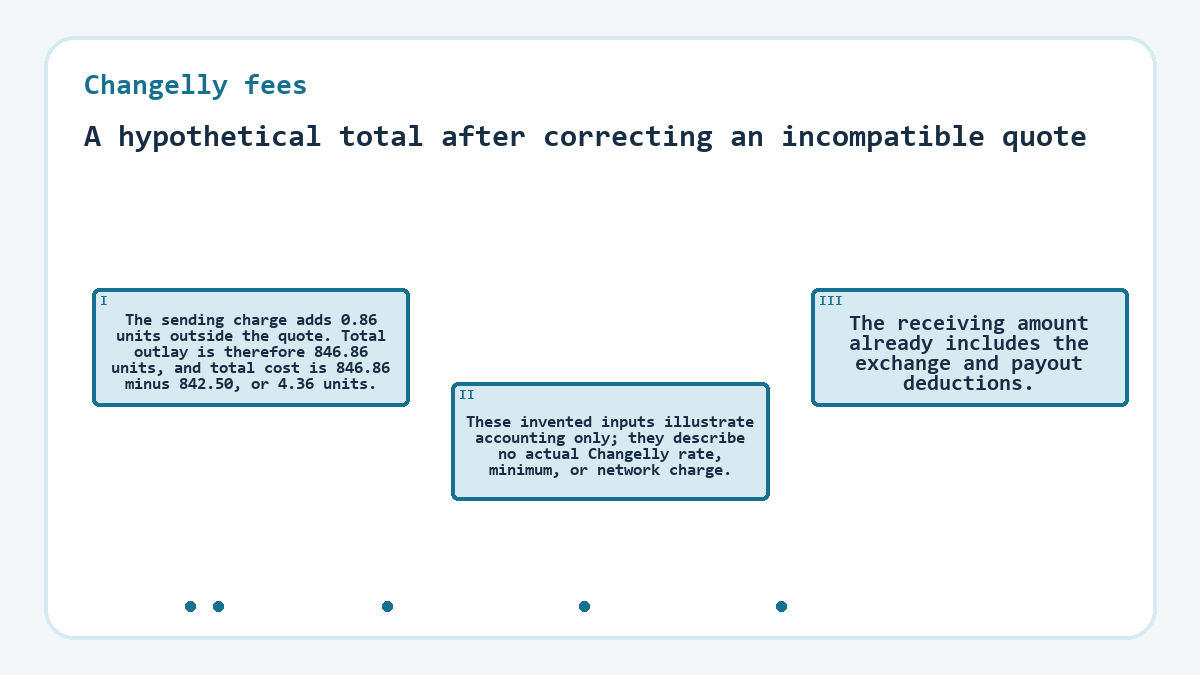
The sending charge adds 0.86 units outside the quote. Total outlay is therefore 846.86 units, and total cost is 846.86 minus 842.50, or 4.36 units. These invented inputs illustrate accounting only; they describe no actual Changelly rate, minimum, or network charge. The receiving amount already includes the exchange and payout deductions.
After the reader funds the compatible order under its terms, the execution record identifies the eventual payout. The receiving account's matching credit establishes what arrived. If its value differs from the estimate, the reader compares asset quantities and charges before attributing the difference to fees. A change in market value alone does not establish another deduction.
Fees, spread, price impact, and slippage affect the final output in different ways
An explicit fee identifies a charge; a quote's difference from a reference price can have several causes.
A spread describes a pricing gap, with the chosen benchmark determining exactly what the comparison measures. Price impact describes how an order's size affects execution pricing through available liquidity. Slippage describes a difference between expected and executed pricing. General market movement can also alter a floating quote between estimation and conversion. A lower final output alone does not reveal which mechanism caused the change.
Call the difference between reference-valued outlay and proceeds an effective cost or value shortfall unless the records identify its components. Do not label the entire difference a Changelly service fee. A public market price may represent a different venue, time, or transaction size. Using it as a benchmark does not prove that amount was available for your exchange.
Fiat purchases require the provider's complete payment total
For a fiat purchase, compare the provider's final payment amount with the cryptocurrency the destination will receive. Changelly's purchase flow shows provider offers, while the provider's processing page supplies the detailed charges before payment. A crypto swap's service-fee formula does not establish a card or bank purchase's total. Include any separate charge your payment account shows, and keep the payment currency consistent across offers.
The completed transaction settles the cost record
The accepted quote records the estimate; the final funding debit and receiving credit establish the completed transaction's quantities. Preserve both, along with the fee breakdown and rate mode. A floating exchange can deliver a different quantity because conversion follows market conditions. That difference needs examination before it becomes a claim about an extra charge.
Use the same valuation snapshot for both sides when calculating the exchange's effective cost. Comparing an earlier funding value with a later wallet valuation mixes exchange costs with subsequent price changes. Reconcile the asset quantities first, then the valuation. The resulting record shows what the transaction consumed and delivered without counting included fees twice.
Common questions about Changelly fees
Will splitting a Changelly exchange into smaller orders reduce its total fees?
Splitting an exchange can increase total transfer costs because separate orders can require separate funding and payout transactions. Each order must also satisfy its own minimum. Compare the combined net outputs and combined funding debits; a smaller fee on each order does not establish a smaller total expense.
Does exchanging back reveal the fee charged on the original swap?
A reverse exchange does not isolate the original fee because it introduces another quote and another set of transaction costs. Rates may also move between exchanges. Use the original funding record, fee breakdown, and receiving amount to examine the first transaction instead of treating a round-trip loss as its service charge.
Which denominator should I use to express the total cost as a percentage?
For a cost percentage based on total outlay, divide the effective cost by total outlay in the same valuation currency, then multiply by 100. State that basis when comparing results. A service percentage calculated against output and an effective cost percentage calculated against funding outlay measure different things.
Can a quote with a lower service percentage deliver less cryptocurrency?
A lower service percentage can still accompany a smaller net payout when exchange pricing or other charges differ. Compare equivalent offers using the same funding basis and compatible destination. The service percentage describes one component; it does not independently determine the amount the receiving wallet obtains.
What records help resolve a disputed fee calculation?
The useful records are the accepted quote, its fee breakdown, the funding debit, and the final payout amount, together with their asset units and timestamps. Keep the order identifier with those records. A wallet's later currency valuation alone cannot establish whether the exchange deducted an additional fee.